
preparing and looking back
considering myself as a writer

Barely containing my excitement as I prepare to commence my sixth semester of college courses, it occurred to me to revisit my past self’s reflections. Specifically, two pieces I wrote on the subject of the subtitle above: considering myself as a writer. Both were written for class, one as a take-home assignment, the other as a ten minute, in-class response.
Even as I anticipate returning to my literature classes and the joy I experience in reading, noticing, and questioning written works, a sense of anxiety accompanies the excited sentiments. I struggle to confide in myself as a writer. I enjoy writing, and whenever I write I’m filled with a renewed sense of gratitude for the gift it is to express one’s ideas, thoughts, musings, etc., in words. At the same time, writing, as an act and as an art, carries a heavy weight. I find it almost burdensome at times, particularly with my consistent desire to write intentionally and artfully. Yet, in response to the question the great poet Rainer Maria Rilke encourages the young Franz Kappus to ask himself—must I write?1 —I say yes. I must write. I want to write. I always want to write more. Writing may be, simultaneously, a burden and a gift. I must embrace the burden’s weight to open its vast wealth. And to open myself.
Preparing to embrace that burden of writing in a new academic semester, what better way than to re-open the gifts of my past self?
I first attach a piece I wrote in August of 2024. Applicably and uncreatively titled, “Why I Write”, I reflect on just that, also in response to the corresponding meditations of George Orwell, Joan Didion, and Elisa Gabbert.
When tasked with reading multiple different essays each titled “Why I Write,” I was immediately called to ponder. What a great title, and fabulous that several writers were inspired to reflect on the subject, I thought. All writers should pen their own essay of that same title. Why does one write? What a thought to truly contemplate, so often overlooked, yet so necessary.
Before approximately 6:37 Monday evening, I’m not sure how many times I’d really considered my own answer. I wrote out the question on paper: why do I write? My initial response turned me to another question: why do I read? I wanted to be careful with that direction of thought. While reading and writing are undoubtedly interconnected, and my reasons for both may be similar in some ways, the two actions are not the same. Even so, I reflected upon my current reasons for reading. I read to broaden my understanding of the world. To hear and ponder different perspectives. To glimpse thoughts or opinions or lifestyles or experiences that I would otherwise never take note of. I read, knowing that my own personal sphere, the sliver of the world I see, is so small. I can only perceive so much with my own senses and my own mind. Reading enables me to hear from others and to broaden my sphere by stepping into the spheres of others.
Writing however…I began to jot down bullet points with the first motivators that came to my mind. The following occurred to me as reasons why I write: to create things of beauty to read; to evoke joy or nostalgia or feeling of some sort; to draw with words; to create scenes that can be visualized. I starred the final point: to create an experience for the reader. That struck me as the key motivator which all the other points came down to in some way or another. I write to create an experience of some sort for the reader based on my perception of the world.
Upon further reflection, it occurred to me that I often do not write for a reader apart from myself. When I write, who do I intend to read my writing, and does that motivation I starred in my notebook always apply? These questions led me to three distinct writing settings I engage in: personal writing for myself, academic writing, and non-academic writing to share. Despite its portrayal in different ways, it is my current understanding that my deepest motivation for writing remains consistent no matter the setting and no matter the audience.
At this current point (though likely to change in the coming weeks with the start of a new academic year,) I most frequently write for myself. Just days ago I took to my journal to document my heightened feelings of excitement, anticipation, and gratitude, prompted by a fulfilling day of encouraging social interaction and spiritual joy. Describing some particular moments—an unexpected compliment received, discovering my cell phone safely on the counter after believing it was lost—I wrote to carefully preserve points that made the day special. Of course, my intention for journaling last Sunday evening was multifaceted. I wanted to reflect upon my feelings by setting them in writing. I did not want to forget the events of the day. However, creating an experience still existed as the underlying motivation. I was creating, or re-creating, the experience of a day that I lived. An experience that I, as the reader, may return to in the future when time has passed or my feelings lie in a different state, simply by picking up my journal.
While some of my writing may be intended for only myself to read, much of it will reach the eyes of other readers, one instance being seen in my academic writing. As I analyze texts and ponder what knowledge enters my mind, I frequently find myself in an environment like this: I sit in the upper common area of Pennington Hall, my Bible open to the Gospel of John, chapter 15, with a filled notebook page nearby. For hours on end, I type and retype on a document, working tirelessly to articulate my deeper understanding of Jesus’ grapevine analogy for my professor’s reading. Though a notably different writing setting from my personal journaling, I continue to write with the purpose of creating an experience. This experience exists in the development of my own understandings, ideas, or opinions through writing. In writing, I possess the ability to express what possibly no other person has considered or understood, at least in the same way that I have. The student or professor reading my paper ultimately steps into my perspective, my experience with a text or academic endeavor.
A final writing setting lies in my non-academic writing intended for readers apart from myself. As an elementary schooler, I would sit at a Word document on a Saturday afternoon and type whatever plot twist came to mind for the current narrative developing at my fingertips. Perhaps someday, I thought, this story will be finished and made into an actual book that will sit at a school library for a girl like me to read. What would another young girl take from my silly tale of several house pets seeking an adventure on the city streets? Perhaps not an experience that I, the author, personally underwent, but an experience that I dreamed up. Under the facade of plot and characters lies a network of my own ideas, mannerisms, and perspectives. Perhaps, like the author Joan Didion, small day-to-day happenings that only I intensely observe will make their way into my writing, opening the reader to my view of the world around me. Regardless, the reader enters into an experience molded by me as the writer.
After reflecting on my underlying reason for writing, how curious to then look back on my reasons for reading. I see my reason for originally considering the two questions together (why I read and why I write.) While I read to experience the perspectives of others, I write to create an experience for another. An experience that only I perceive, established in the unique way I articulate it in writing. As I work to combine words in a beautiful or effective way, with the intention to evoke feeling, with the desire to create a distinct visual, or with the hope of expressing my thoughts accurately, I write with my own lens on the world. By writing, I allow others to look at the world through my lens, just as I look at the world through the lenses of others when I read their writing.
The following reflection responded to a general prompt to observe self and writing: inspirations, realities, hopes. A brief period of class time was allotted to consider the topic (which I remember finding overwhelming; I had so much to think about, so much to write, so little time!) Even so, I re-read the thoughts I did manage to get down on paper with fondness and, despite having written it approximately 363 days ago today, in agreement.
Beginning Haiku
Pondering myself.
Consider inspiration.
I write to express.
As I consider and imagine where I want to go with my writing, who I want to become, my thoughts traverse all sorts of different paths. As with many spheres of life, my enthusiasm and passion for exploring brings me joy in the variety. This very much applies to my writing.
I consider the “types” of writing that engage me. At the present moment in my life, I view myself as an academic writer. I enjoy analyzing, asking questions, seeking to understand, to learn. And I enjoy revealing this in writing and using writing as a tool of expression for study and questioning. I also know myself to be a creative writer. While I have not engaged deeply in this sort of writing for a number of years, my young self developed narratives for hours on end. I value the art of story, and the creative writer lives within me, though perhaps presently overshadowed by the academic writer. Finally, I also desire to pursue what I will refer to as the “artistic writer”—that who pursues poetic verse, or writing with less-specific rules. I have not written much poetry, but I love to read it, and I love to explore it. To notice. As a visual artist, poetry feels like one of the most diverse and artistic areas of the writing world. I hope to further explore and practice poetic writing.
I also consider writers who inspire me. I think I aspire to become a writer formed by the many who come before me. I hope to grow from the variety around me, becoming a melting pot of personal inspirations and inspirations of genres.
Alas, a new year, a new month, a new semester, and new writing to come. Perhaps I can ground myself, remembering my foundations: writing to create an experience, to be inspired and to inspire, to explore, to express, and, always at first, to start.
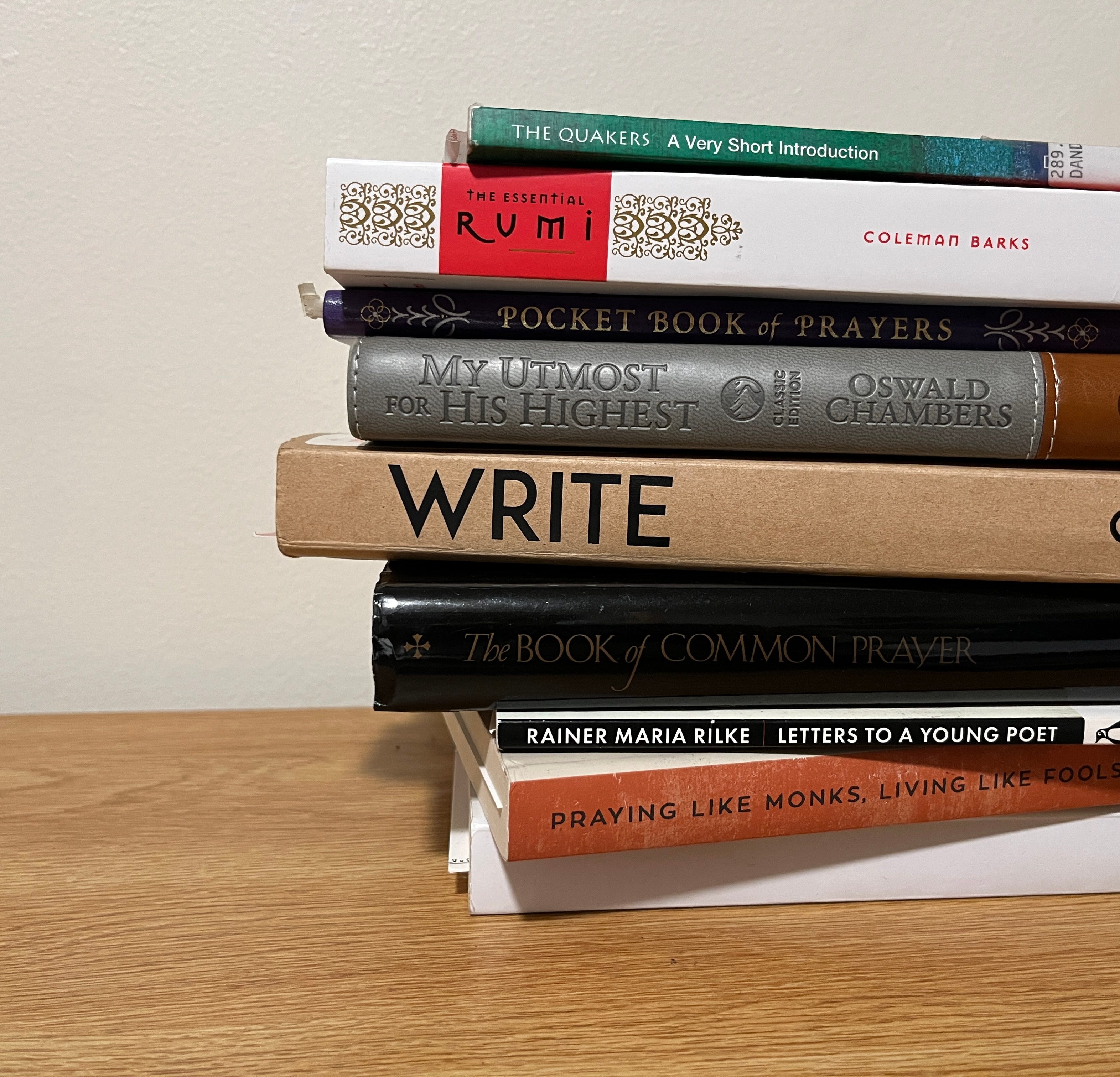
Rilke, Rainer Maria. Letters to a Young Poet & The Letter from the Young Worker. Translated by Charlie Louth. London: Penguin Classics, 2011.
!!!